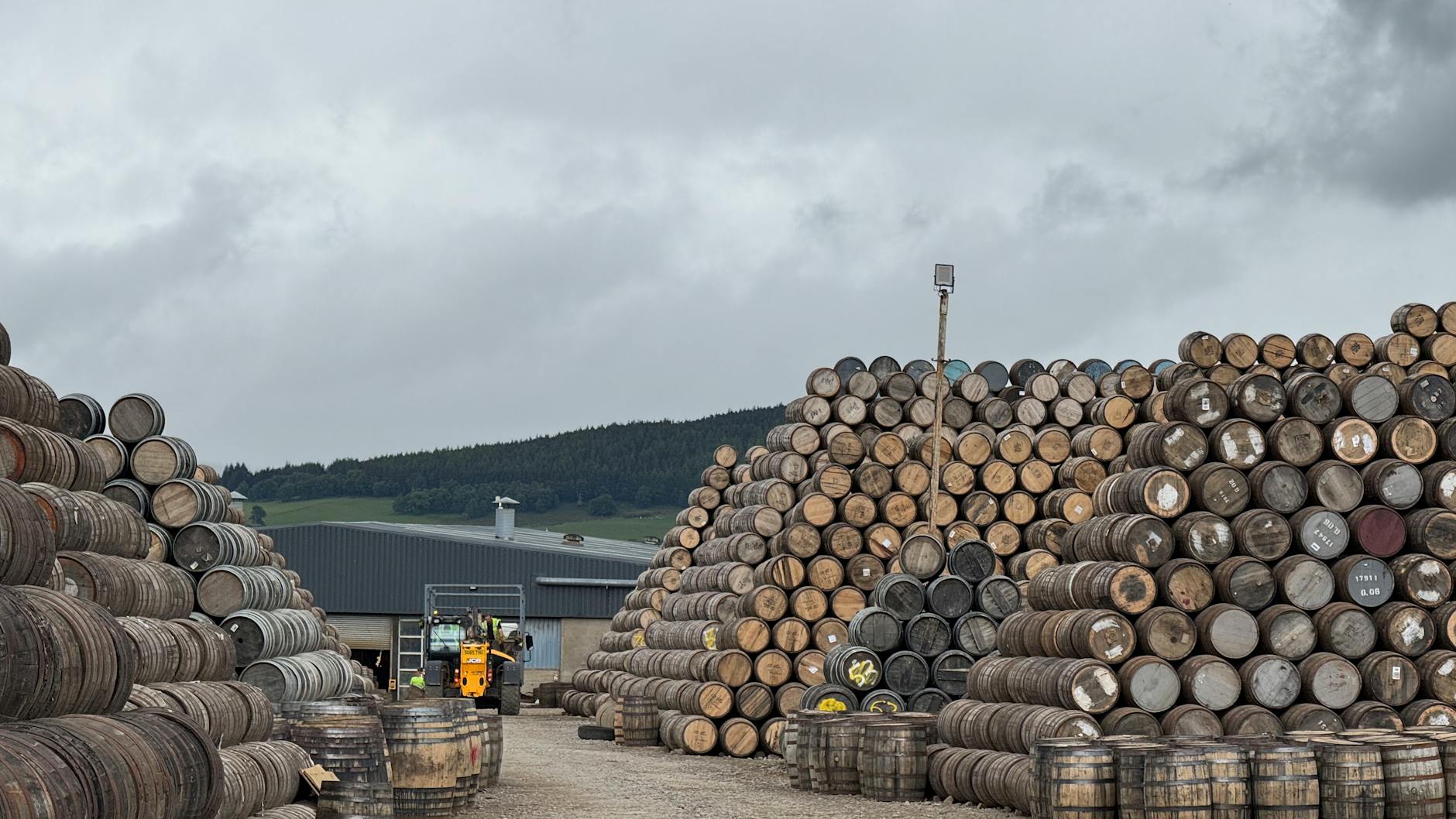
US spirits volumes fell for a second year while RTD cocktails grew to 8% market share. For cask investors, softening retail sentiment and a 10-20% price correction from peak create a potential entry window as physical scarcity continues to build.
RTD Cocktails Signal a Structural Shift in the US Spirits Market
US spirits volumes fell for the second consecutive year in 2024, with the Wine and Spirits Wholesalers of America (WSWA) reporting a broad-based contraction driven by consumer downtrading — a pattern that historically reshapes category winners and losers for years afterward. Against that backdrop, ready-to-drink (RTD) cocktails posted category growth, earning the designation of "bright spot" from WSWA analysts who track wholesale movement across the country's distribution network. For investors positioned in premium spirits assets — whisky casks, aged rum, or rare bottlings — this divergence is not a footnote; it is a leading indicator of where consumer and institutional capital is migrating.
If you manage a portfolio that includes alternative assets, the WSWA data matters personally because it affects the secondary market pricing of the underlying liquid you hold. When consumers trade down at retail, the aspirational premium attached to aged, rare, or single-distillery spirits does not evaporate — it concentrates. Collectors and investors with long time horizons have seen this dynamic before: the post-2008 austerity period was followed by a decade of record auction prices for Scotch whisky. Understanding the current cycle early is what separates a well-timed allocation from a reactive one.
The Numbers Behind the Downtrading Pressure
The WSWA's 2025 market outlook confirmed that total US distilled spirits volumes declined in both 2023 and 2024, with premium and super-premium categories absorbing disproportionate softness as household budgets tightened under the cumulative weight of post-pandemic inflation. According to IWSR data, the US spirits market contracted by approximately 1.8% by volume in 2024, with bourbon and American whiskey — long the darlings of the premiumisation era — seeing their growth rates stall after years of double-digit expansion. Tequila, which had been the category's engine, also showed signs of deceleration as agave supply costs remained elevated.
RTD cocktails, by contrast, grew volume share to approximately 8% of total US alcohol by volume in 2024, up from under 4% five years ago, according to IWSR tracking. The category's appeal is straightforward: RTDs deliver a cocktail experience at a lower per-serve price than on-premise consumption, making them a natural beneficiary of belt-tightening. What is less obvious — and more relevant to investors — is that several of the fastest-growing RTD brands are owned by or licensed from premium distilleries, meaning the brand equity of the underlying spirits asset is being monetised at scale even as bottle sales soften. Brands including Cutwater Spirits (owned by Anheuser-Busch InBev), High Noon (E&J Gallo), and Tip Top Proper Cocktails have demonstrated that the RTD format can serve as a demand bridge, keeping consumers engaged with a spirit's flavour profile at an accessible price point until their spending power recovers.
"When consumers trade down at retail, the aspirational premium attached to aged, rare spirits does not evaporate — it concentrates. The post-2008 austerity period was followed by a decade of record auction prices for Scotch whisky."
What This Means for Whisky Cask and Fine Spirits Investors
The investment thesis for whisky casks has always rested on a simple but powerful dynamic: liquid matures in barrel regardless of what the retail market is doing, and the passage of time is irreversible. A cask of Speyside single malt laid down in 2022 will be three years older in 2025, and the angel's share — the evaporation that occurs annually, typically 1–2% in Scottish warehouses — means the remaining volume is simultaneously scarcer and more concentrated in flavour. According to Rare Whisky 101, the Apex 1000 index, which tracks the 1,000 most sought-after Scotch whisky bottles at auction, appreciated by over 130% between 2015 and 2022 before entering a period of correction in 2023–2024 alongside broader luxury asset softness.
That correction, however, mirrors almost exactly the pattern seen in 2012–2014, when a post-financial-crisis hangover briefly suppressed auction prices before a sustained bull run through the late 2010s. Investors who entered the cask market during the 2013–2015 window — when sentiment was cautious and entry prices were compressed — captured the majority of the subsequent decade's appreciation. The current environment, where US spirits volumes are contracting and secondary market enthusiasm has moderated from its 2021–2022 peak, shares structural similarities with that earlier window. Scotch whisky cask prices at specialist brokers have softened 10–20% from their highs depending on distillery and age, according to industry participants, creating potential entry points for investors with a five-to-ten-year horizon.
Specific distilleries warrant attention in this context. Glenfarclas, Springbank, and GlenDronach have historically commanded strong secondary premiums because of limited independent bottler availability and devoted collector bases that sustain floor prices even during softer retail periods. On the Irish side, Midleton — the source of Redbreast and Method and Madness expressions — has seen cask valuations hold firm as Japanese and Asian buyers continue to absorb allocations. At auction, Bonhams, Sotheby's, and specialist platforms including Whisky Auctioneer and Scotch Whisky Auctions continue to report robust hammer prices for aged single casks above 15 years, even as entry-level bottles soften.
Source: Whisky Bulletin coverage of japanese whisky on Whisky Bulletin.
💼 Interested in alternative asset investment? Speak to the team at Whisky Cask Club — Singapore's leading whisky cask investment specialists.
Key Investment Metrics: RTD Growth vs. Premium Spirits Assets
The following data points frame the current opportunity for investors evaluating spirits-adjacent alternative assets. Each figure is drawn from publicly available industry research and auction house reporting.
- US spirits volume decline (2024): Approximately -1.8% by volume, per IWSR, marking the second consecutive year of contraction.
- RTD cocktail market share (2024): ~8% of total US alcohol by volume, up from under 4% in 2019 — a doubling in five years, per IWSR.
- Rare Whisky 101 Apex 1000 Index appreciation (2015–2022): +130%, one of the strongest sustained runs among tracked alternative asset classes over that period.
- Scotch whisky cask price correction (2023–2024): 10–20% from peak levels depending on distillery and age profile, per specialist broker estimates — compressing entry costs for new investors.
- Angel's share evaporation rate (Scottish warehouses): 1–2% per annum, meaning a 10-year-old cask has lost roughly 15–20% of its original fill volume to evaporation alone, directly increasing per-litre scarcity and value of the remaining liquid.
Taken together, these figures describe a market where the mass-market consumer is trading down, the secondary auction market has corrected from speculative highs, and the underlying physical asset continues to appreciate through the irreversible chemistry of maturation. That combination — sentiment softness plus structural scarcity — is precisely the environment that has historically rewarded patient, well-researched entry into cask investment.
What to Watch: Forward-Looking Signals for Spirits Investors
Several near-term developments will determine whether the current softness in US spirits translates into sustained secondary market opportunity or a more prolonged correction. The Federal Reserve's interest rate trajectory matters: higher-for-longer rates compress discretionary spending and increase the opportunity cost of illiquid alternative assets, while rate cuts would likely stimulate both consumer spirits spending and investor appetite for tangible assets. Watch the Fed's quarterly dot plot alongside WSWA wholesale data releases for early signals.
Asian demand — particularly from Singapore, Taiwan, and mainland China — remains a critical price support for aged Scotch and Japanese whisky casks. Any recovery in Chinese consumer confidence following the post-Covid malaise would materially tighten supply of well-aged liquid, as Chinese buyers have historically absorbed large volumes of aged Scotch at both retail and auction. The Hong Kong auction calendar, including Bonhams and Christie's biannual sales, serves as a real-time barometer of Asian appetite. Investors should monitor hammer-price-to-estimate ratios at these sales as a leading indicator of demand depth, not just headline totals.
Finally, the RTD category's continued growth has a secondary effect on cask investors: as major distilleries commit more of their production to RTD licensing deals and blending contracts, the proportion of aged single-cask liquid available to the secondary market tightens. Diageo, Pernod Ricard, and Beam Suntory have all expanded RTD partnerships in the past 24 months, and that diversion of production capacity away from aged single malts and single barrels structurally supports long-term cask scarcity. For investors holding casks from distilleries with active RTD programmes, this is an underappreciated tailwind.
Frequently Asked Questions
Why are US spirits sales declining while RTD cocktails are growing?
US spirits sales are contracting primarily because consumers are downtrading — reducing spend on premium bottles consumed at home or on-premise as household budgets remain stretched by post-pandemic inflation. RTD cocktails benefit from this environment because they deliver a cocktail-quality experience at a lower per-serve cost than either on-premise consumption or buying a full bottle of premium spirit. The WSWA's 2025 data confirms this bifurcation is structural, not seasonal.
Does a weaker US spirits market hurt whisky cask investment values?
Not directly, and often the opposite is true over a medium-to-long horizon. Whisky cask values are driven by scarcity, age, distillery reputation, and secondary auction demand — not by retail bottle sales in any single market. Periods of retail softness have historically been followed by strong secondary market appreciation as pent-up collector demand meets constrained supply of aged liquid. The 2013–2015 correction and subsequent bull run is the clearest recent precedent.
Which distilleries offer the strongest investment case for cask buyers right now?
Distilleries with limited independent bottler availability, strong collector communities, and constrained production capacity tend to hold cask values best during softer periods. Springbank, Glenfarclas, and GlenDronach in Scotland, and Midleton in Ireland, have demonstrated this resilience. Japanese distilleries including Chichibu and Nikka's Yoichi remain in high demand but are difficult to access as direct cask investments for non-Japanese buyers. Always verify cask provenance, warehouse documentation, and independent valuation before committing capital.
How does the RTD boom affect the long-term supply of aged whisky casks?
As major distilleries divert more new-make spirit into RTD blending contracts and licensing agreements, less liquid enters long-term maturation as single-cask inventory. Over a 10–15 year horizon, this reduces the supply of aged single casks available to the secondary market, which is structurally supportive of cask valuations for investors already holding aged stock. This dynamic is most pronounced at large distilleries with active RTD programmes, such as those owned by Diageo and Pernod Ricard.
💼 Interested in alternative asset investment? Speak to the team at Whisky Cask Club — Singapore's leading whisky cask investment specialists.